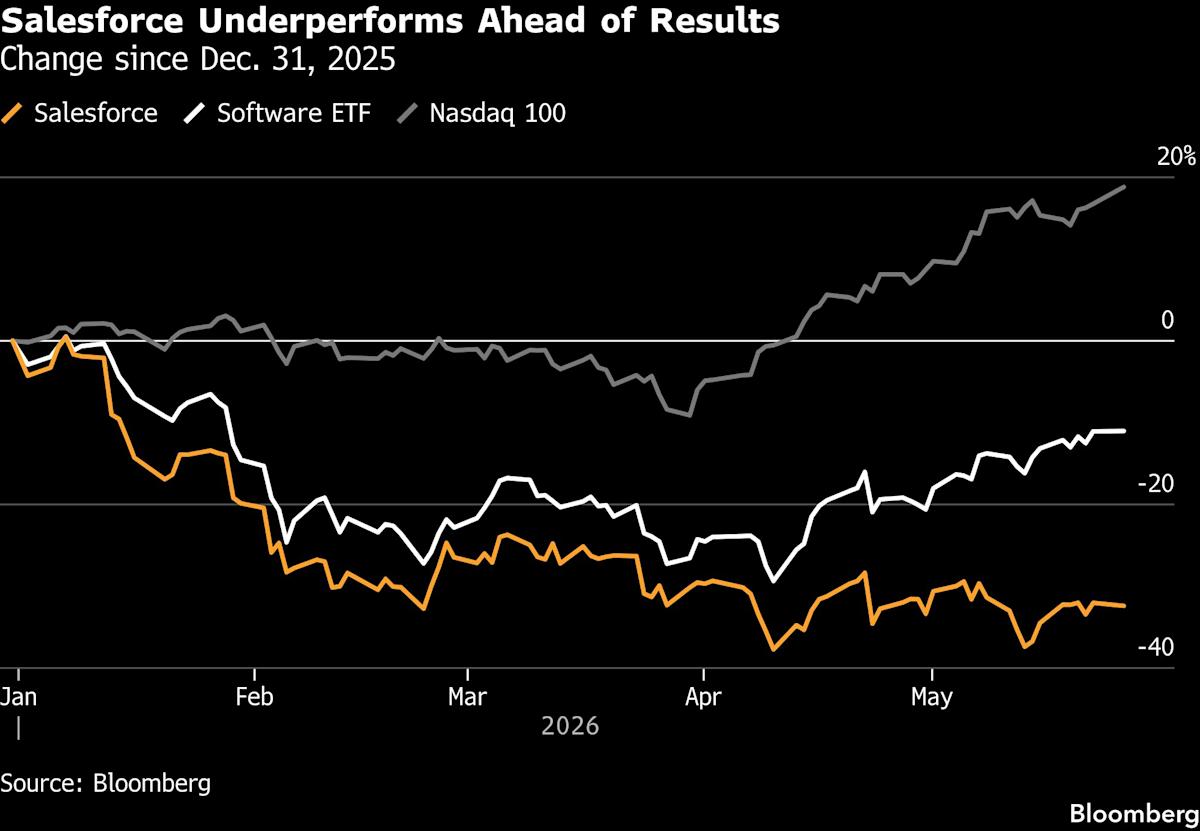
(Bloomberg) -- While software stocks rebound from the artificial intelligence-driven wipeout earlier this year, Salesforce Inc. hasn’t really benefited. But its earnings after the close Wednesday could pull the company’s shares out of their malaise.
Most Read from Bloomberg
Salesforce is up 8% since hitting a three-year low on April 10, but the stock still has lost 32% this year. It’s badly underperforming the iShares Expanded Tech-Software Sector exchange-traded fund, which has jumped 25% since hitting its own recent low on April 10 and is down 12% this year. And both are being trounced by the technology-heavy Nasdaq 100 Index’s 19% rise in 2026, largely powered by high-flying chipmakers.
Salesforce shares dipped 0.1% on Wednesday afternoon.
“It has gone through a very painful period, but there’s a stickiness and staple-like nature to the business that people have underestimated, even though revenue is still growing at a decent pace,” said Brian Kersmanc, portfolio manager at GQG Partners, which owns Salesforce shares. “Now that we’ve had this big washout, I think we’re going to start seeing the merits shine through.”
Software stocks are getting some life as encouraging corporate earnings reports indicate that AI may not end up devastating growth like investors had assumed, and in some cases it could be a potential tailwind. That, coupled with valuations that fell to rock-bottom levels, has Wall Street thinking that the industrywide weakness from earlier this year may have gone too far.
Salesforce, however, has missed much of the bounce back as it continues to face questions about its prospects. Wall Street’s primary concern is competition from Anthropic and OpenAI weakening demand and pricing power for its customer relationship management software, which for years drove robust growth at high margins.
For example, Bank of America last week reinstated coverage of the company with an underperform rating due to “structurally lower growth” and greater competitive risks from AI.
“Salesforce remains a deeply entrenched platform, yet we expect a structural reset driven by AI transition that raises three core concerns: muted net new customer additions, limited up-sell potential, and an underwhelming AI monetization pathway,” BofA analyst Tal Liani wrote in the note. “The company is transforming from a historically high growth platform to a mature cash generator.”
The anticipated AI disruption is more apparent in sentiment surrounding Salesforce than in its actual fundamentals, at least so far. The company is expected to post revenue growth of 11% in fiscal 2027, which ends in January, up from 9.6% in fiscal 2026, according to data compiled by Bloomberg. Meanwhile, the stock is about the cheapest it has ever been, trading for just 13 times estimated earnings, below its 10-year average of 45. Salesforce’s multiple hit an all-time low two weeks ago and has been less than 30 for over a year.
“It is incredibly arduous for businesses to even switch CRM providers, given all the legal and compliance and operational issues, so I don’t think there’s much to the idea that Salesforce can be replaced through vibe-coding,” said Kersmanc, referring to users writing code with AI, which is seen as a significant risk for software makers. “As people become more comfortable it isn’t being disrupted, I think it’ll re-rate higher. Double-digit growth at a low-teens multiple looks really attractive.”
He isn’t alone in that view. Of the 62 analysts tracked by Bloomberg that cover Salesforce, 47 have buy ratings and their average price target of $253 indicates the stock will rise 39% in the coming 12 months. That’s one of the strongest implied returns in the S&P 500 tech sector, according to data compiled by Bloomberg.
Software companies have had a strong earnings season, with roughly 87% topping expectations for earnings and revenue, higher beat rates than for the S&P 500 overall, according to data compiled by Bloomberg. Only 71% of software companies topped revenue expectations in the prior earnings season.
For Salesforce, the question remains whether its products are about to be displaced by AI. Stephen Bersey, head of technology research at HSBC, doesn’t agree with the pessimism, largely because much of the value of what the company sells comes from proprietary data and how deeply the programs are embedded across its customers’ enterprises. Oracle Corp., Microsoft Corp. and ServiceNow Inc. are also in this position, he said, unlike companies that sell more niche applications like developing apps or photo editing, which are more at risk of AI disruption.
“AI represents one of the most significant monetization opportunities for software that I’ve seen in several decades,” he said. “It is ironic to me that as we sit in front of a golden age of software, powered by AI, that the market is the most pessimistic about the sector as it has ever been.”
Tech Chart of the Day
The surge in memory-chip stocks is intensifying, sending the market capitalizations of SK Hynix Inc. and Micron Technology Inc. above $1 trillion for the first time, as investors bet the AI boom will lead to a sustained revaluation of the industry.
Top Tech Stories
-
Samsung Electronics Co. union members voted in favor of a compensation deal that will hand chip workers an average bonus of about $340,000, staving off a strike that threatened to disrupt global chip supply.
-
FTSE Russell adopted a rule change that will speed the addition of newly listed large-cap companies to its main indexes, weeks ahead of SpaceX’s expected record-breaking initial public offering.
-
India is undertaking tests of some of its most sensitive public-facing financial and government application software to better understand their vulnerabilities to Anthropic PBC’s next-generation Mythos AI model, according to Indian officials familiar with the matter.
Earnings Due Wednesday
-
Earnings Premarket:
-
Earnings Postmarket:
-
HP Inc. (HPQ US)
-
Nutanix Inc. (NTNX US)
-
Salesforce Inc. (CRM US)
-
Synopsys Inc. (SNPS US)
--With assistance from Subrat Patnaik, David Watkins, Sangmi Cha and Youkyung Lee.
(Updates to afternoon trading.)
Most Read from Bloomberg Businessweek
©2026 Bloomberg L.P.